
Recently on Threads, discourse around “being disabled but not autistic” has been frequent.
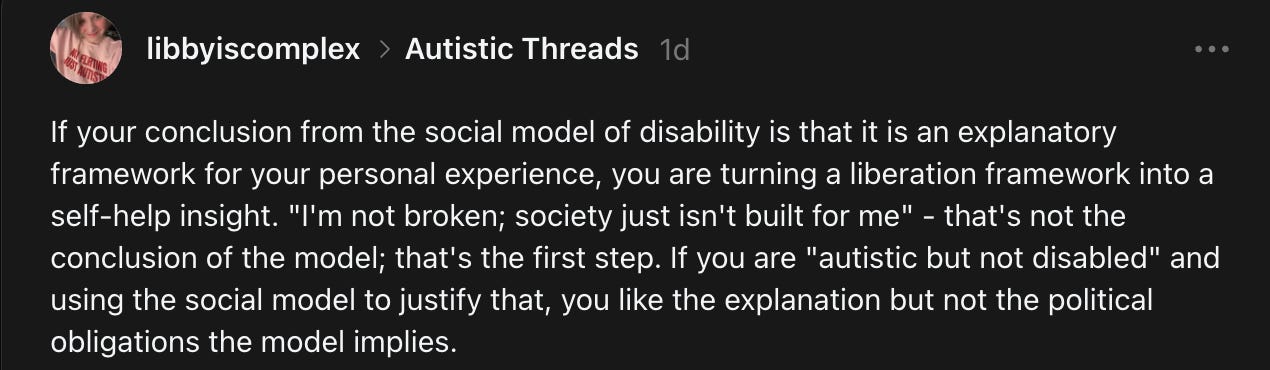
Within Threads and other online spaces, people often use the social model of disability’s logic to arrive at conclusions it was never designed to support.
The social model of disability makes a specific political claim: disability is produced by social structures, not by bodies. The staircase disables the wheelchair user. The sensory environment of the open-plan office disables the autistic employee. The problem is located in the structure. The solution is structural change.
This model emerged from the disability rights movement in the 1960s and 1970s. Activists needed a framework that said the building is the problem, not the wheelchair. They built one. It changed law and lives. It remains one of the most important contributions to disability rights in the last century.
It was also, from the beginning, a liberation framework. Its purpose was collective political action, and its endpoint was organizing, not self-understanding.
Oftentimes, people new to the disability community encounter the social model and land on its first move: I’m not broken. Society just isn’t built for me.
This is real. For a lot of people (and specifically within the autism community, newly diagnosed autistic adults carrying decades of internalized shame), it’s one of the most important realizations of their lives. That is profound.
It’s also the first step of an argument for collective liberation. The argument for the social model continues: this structural oppression is happening to all of us. We have collective interests that require collective action. Our collectivity is called disability, and it is political, and you are welcome.
The self-help version stops before collective action arrives. It takes the personal insight - I’m not broken - and treats it as the conclusion. The framework that was built to say “we organize now” is being used to say “I understand myself now.” What remains is a a valuable reframe with its political teeth removed.
This misapplication starts in a place that makes sense and moves toward something extractive. From I feel better about myself to I don’t owe anyone solidarity is a series of subtle moves. Each one looks reasonable in isolation.
People take the social model’s claim that disability is contextual, and use that to exit the category of “disabled” entirely. “If disability is produced by society, and I arrange my life so society doesn’t disable me, then I’m not disabled.” This exit reads the model as a diagnostic tool (“what causes my disability”) instead of a political framework (“what do we do about structural exclusion”). The model was never designed to say that if you personally circumvent the structures, you are no longer disabled. The model is about collective structural conditions, not individual arrangements.
This matters because the self-help exit misreads the model at a foundational level. The social model makes a political claim: structures produce disablement, and we organize to change the structures. The self-help version applies this to an individual life: structures produce my disablement, and if I changed those structures, I would no longer be disabled.
Limitations
The social model does have genuine limits.
The model locates disability in the environment, but some things aren’t environmental.
The social model’s power is in locating disability outside the body. It challenged the medical model by offering the reframe from “something is wrong with you” to “something is wrong with the structure.”
However, bodies do matter. Pain is not a structural failure. The body producing difficulty independent of the environment is not a problem the social model was built to fully address.
This isn’t a criticism of the model, but a recognition of scope.
The social model’s goal was never the elimination of disability. It was the elimination of structural violence toward disabled people. In an accessible society, disabled people still exist. They still need accommodation. What’s been eliminated is the exclusion, not the category. The political identity persists because the needs that organize it persist.